The Lake Tahoe snowpack was so thin that even Alpine Meadows was planning to close in mid-April.
But recently nine feet of snow arrived. (Yes, feet, not inches.)
To demonstrate the impact on backcountry snow stability, here is a video of an avalanche forecaster's Propagation Saw Test:
Wednesday, March 21, 2012

Tuesday, March 20, 2012
Norwegian Avalanche
All avalanches are of course bad, but this one was especially bad: five dead (reportedly four Swiss, one French), from a ship-based tour (i.e., think mobile floating hut). Only one buried victim survived, who according to a TGR poster from Svalbard was a guide, buried up to his neck. Dale Atkins reports that a touring group of 12 was split into two separate parties of 6 each, so that implies that all members of one party were buried, with only the guide surviving.
Dale Atkins also reports that as many as eight helicopters transported rescuers and victims, and that the Royal Norwegian Air Force flew at least one F-16 for observation assistance.
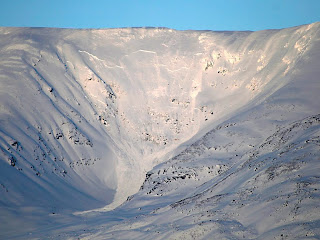
As shown in the picture below, a very wide crown line (reportedly spanning one kilometer), and with lots of vertical relief, funneled into a relatively narrow runout zone. One victim was extricated from beneath six meters of snow. [Update: the deepest burial was actually eight meters.]
Same picture below, but with a circle around a Sea King helicopter (barely visible) to convey scale (thanks to another TGR poster from Norway):

Picture from a different perspective:

Some additional details in this Washington Post write-up.
Educational angle? A TGR poster states that the name of the mountain in the indigenous people's tongue translates as The Deadly Mountain. With terrain like this, you had better be 100% sure that the snow is 100% stable. All victims are thought to have been equipped with airbag packs, with at least two "successful" deployments, but entrainment in an avalanche like this is nearly hopeless.
Also, when in a group, always observe, think, and act as if you are alone. Even with professional guides, be involved in the decision making process, and if you have concerns, then speak up.
Anyone can make a mistake, professionals included. And even if you agree entirely with the guide's decisions, being involved in the process will help prepare you better for unguided tours.
Dale Atkins also reports that as many as eight helicopters transported rescuers and victims, and that the Royal Norwegian Air Force flew at least one F-16 for observation assistance.
As shown in the picture below, a very wide crown line (reportedly spanning one kilometer), and with lots of vertical relief, funneled into a relatively narrow runout zone. One victim was extricated from beneath six meters of snow. [Update: the deepest burial was actually eight meters.]

Same picture below, but with a circle around a Sea King helicopter (barely visible) to convey scale (thanks to another TGR poster from Norway):
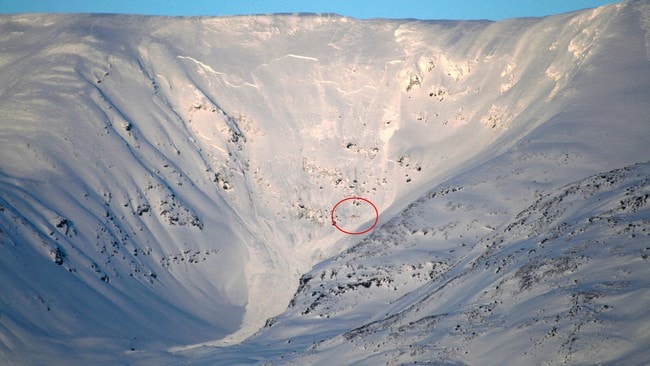
Picture from a different perspective:

Some additional details in this Washington Post write-up.
Educational angle? A TGR poster states that the name of the mountain in the indigenous people's tongue translates as The Deadly Mountain. With terrain like this, you had better be 100% sure that the snow is 100% stable. All victims are thought to have been equipped with airbag packs, with at least two "successful" deployments, but entrainment in an avalanche like this is nearly hopeless.
Also, when in a group, always observe, think, and act as if you are alone. Even with professional guides, be involved in the decision making process, and if you have concerns, then speak up.
Anyone can make a mistake, professionals included. And even if you agree entirely with the guide's decisions, being involved in the process will help prepare you better for unguided tours.
Thursday, March 15, 2012
Course Dates for 2012-13 Season
Yes, a little bit early to be planning for the 2012-13 season, but given our current heat wave and meager snowpack, perhaps not (sigh...).
The fall session (mainly classroom, along with some outdoor practice in beacon searching and probe lines, plus a short fitness hike with full winter packs), will be on a November weekend day, most likely November 18 (Sunday), although that could change to a day (or even a week) earlier if we need to juggle conflicts with facility reservations and ski patrol refreshers.
The winter fall sessions will be the weekend of March 2-3.
Details on course content and registration here:
http://avycourse.blogspot.com
http://avycourse.blogspot.com/2010/04/course-format-syllabus-dates.html
http://avycourse.blogspot.com/2010/04/registration-form.html
Also, the Mountain Travel & Rescue ("MTR") level 1 course will be held the weekend of October 20-21 on Mt Greylock:
http://mtr1.blogspot.com
The MTR curriculum is best described as an eclectic mix of basic backpacking skills and low-angle rope rescue. In keeping with the general approach of the avalanche course, lots of homework assignments before the weekend of the course, but then that means the weekend of the course is reserved for actual hands-on activities. We start off indoors on the first day only to review our packs and practice basic navigation skills, then we wrap up indoors on the second day with some rescue sled construction. Otherwise, we're outside, include an overnight campout up on Mt Greylock.
Although the course takes place in the fall, students must pack clothing, shelters, and cooking systems as if we were anticipating winter weather, so as to prepare better for winter ski mountaineering.
The fall session (mainly classroom, along with some outdoor practice in beacon searching and probe lines, plus a short fitness hike with full winter packs), will be on a November weekend day, most likely November 18 (Sunday), although that could change to a day (or even a week) earlier if we need to juggle conflicts with facility reservations and ski patrol refreshers.
The winter fall sessions will be the weekend of March 2-3.
Details on course content and registration here:
http://avycourse.blogspot.com
http://avycourse.blogspot.com/2010/04/course-format-syllabus-dates.html
http://avycourse.blogspot.com/2010/04/registration-form.html
Also, the Mountain Travel & Rescue ("MTR") level 1 course will be held the weekend of October 20-21 on Mt Greylock:
http://mtr1.blogspot.com
The MTR curriculum is best described as an eclectic mix of basic backpacking skills and low-angle rope rescue. In keeping with the general approach of the avalanche course, lots of homework assignments before the weekend of the course, but then that means the weekend of the course is reserved for actual hands-on activities. We start off indoors on the first day only to review our packs and practice basic navigation skills, then we wrap up indoors on the second day with some rescue sled construction. Otherwise, we're outside, include an overnight campout up on Mt Greylock.
Although the course takes place in the fall, students must pack clothing, shelters, and cooking systems as if we were anticipating winter weather, so as to prepare better for winter ski mountaineering.
Wednesday, March 14, 2012
"hoy por tí, mañana por yo"
Last year around this time I read a story about a stranded motorist sitting in a friend's borrowed car with a tire blowout but without a jack, watching three hours of traffic (including tow trucks) drive by indifferently, until finally saviors stop in the unlikely form of two Mexican migrant fruit pickers (who don't even speak English) and their children. After much difficult, filthy, sweaty work by the motorist and the Mexican husband (including breaking the tire iron of the Mexican husband, whose wife immediately drives off to buy a replacement), the motorist tries to give the husband a $20 bill, but with no success. He then succeeds in giving the money to the wife.
As they are about to depart, a daughter who speaks English asks the motorist if he'd had lunch yet, then runs over a tamale to him. He opens up the foil to find not only a delicious tamale, but also his $20 bill. He runs back to the Mexicans and desperately tries yet again to convince the husband to accept some financial compensation for such valuable help from a family that is clearly of exceedingly limited means. The husband just shakes his head no, smiles, and then mustering all his command of English, speaks so much with just four words:
"Today you, tomorrow me."
Some searching informs me that this was his translation of a Spanish saying, "hoy por tí, mañana por yo."
And such is the theme of an avalanche transceiver, as it both receives for you and transmits for me. By contrast, a probe and shovel are only for you; a helmet, Avalung, and airbag pack are only for me.
About three years and one month ago, Rob Liberman was skiing near his home base of Telluride -- a day before heading up to Alaska for his spring heliski guiding job -- when he and his touring partner heard an avalanche, went to investigate, and turned their transceivers to receive in case anyone else in need was on transmit.
The first thing the completely buried victim remembers after blacking out during the avalanche's violent ride was a stranger, Rob Liberman, holding the victim's head and saying, "Thank God. We have you. Calm down. Breathe."
Yesterday, Rob Liberman was hit by an avalanche while heliski guiding. Other skiers, including from another party, turned their transceivers to receive for his transceiver that was on transmit.
I wish this story had a happy ending. (And even worse, a client injured in the same avalanche is currently "clinging to life." [Unfortunate update: the client died in a Seattle hospital the day after the avalanche.])
I didn't recognize his name when I first read the tragic news, but my email archives turned up an exchange from this past fall in his position at DPS skis. Sure, he wanted to sell DPS skis because he worked for DPS skis, but I could also tell that he thought skiing on DPS skis made skiing more fun, and he wanted more skiers to have more fun.
I was about to conclude that the next time I'm having fun skiing (which is of course every time I'm skiing, since that's why we ski, right?), I'll dedicate some turns to Rob. But no, that's just more about me.
Instead, the next time I can do something to help someone whom I don't know -- even if it's far less dramatic and important than Rob's save three years ago of a complete stranger's life -- I'll dedicate that to Rob.
As they are about to depart, a daughter who speaks English asks the motorist if he'd had lunch yet, then runs over a tamale to him. He opens up the foil to find not only a delicious tamale, but also his $20 bill. He runs back to the Mexicans and desperately tries yet again to convince the husband to accept some financial compensation for such valuable help from a family that is clearly of exceedingly limited means. The husband just shakes his head no, smiles, and then mustering all his command of English, speaks so much with just four words:
"Today you, tomorrow me."
Some searching informs me that this was his translation of a Spanish saying, "hoy por tí, mañana por yo."
And such is the theme of an avalanche transceiver, as it both receives for you and transmits for me. By contrast, a probe and shovel are only for you; a helmet, Avalung, and airbag pack are only for me.
About three years and one month ago, Rob Liberman was skiing near his home base of Telluride -- a day before heading up to Alaska for his spring heliski guiding job -- when he and his touring partner heard an avalanche, went to investigate, and turned their transceivers to receive in case anyone else in need was on transmit.
The first thing the completely buried victim remembers after blacking out during the avalanche's violent ride was a stranger, Rob Liberman, holding the victim's head and saying, "Thank God. We have you. Calm down. Breathe."
Yesterday, Rob Liberman was hit by an avalanche while heliski guiding. Other skiers, including from another party, turned their transceivers to receive for his transceiver that was on transmit.
I wish this story had a happy ending. (And even worse, a client injured in the same avalanche is currently "clinging to life." [Unfortunate update: the client died in a Seattle hospital the day after the avalanche.])
I didn't recognize his name when I first read the tragic news, but my email archives turned up an exchange from this past fall in his position at DPS skis. Sure, he wanted to sell DPS skis because he worked for DPS skis, but I could also tell that he thought skiing on DPS skis made skiing more fun, and he wanted more skiers to have more fun.
I was about to conclude that the next time I'm having fun skiing (which is of course every time I'm skiing, since that's why we ski, right?), I'll dedicate some turns to Rob. But no, that's just more about me.
Instead, the next time I can do something to help someone whom I don't know -- even if it's far less dramatic and important than Rob's save three years ago of a complete stranger's life -- I'll dedicate that to Rob.
Tuesday, March 13, 2012
"In case I'm . . ."
A recent TGR exchange reminded me of the variations I've had on the following conversation with various partners over the years before late-spring and early summer tours in the Sierra and PNW:
He- "Do you think we should bring avy rescue gear?"
Me- "Yes."
He- "So . . . you think our route might have avy danger?"
Me- "No."
He- "Then why should we bring avy rescue gear?!?"
Me- "In case I'm wrong."
He- "Do you think we should bring avy rescue gear?"
Me- "Yes."
He- "So . . . you think our route might have avy danger?"
Me- "No."
He- "Then why should we bring avy rescue gear?!?"
Me- "In case I'm wrong."
Monday, March 12, 2012
Steve Romeo Outside Mag Interview
Outside Online (the website of Outside Magazine) claims to have interviewed Steve Romeo a vaguely defined "few days" before his fatal avalanche.
As published by Outside, here are the three final exchanges of the interview:
As published by Outside, here are the three final exchanges of the interview:
One thing that’s fascinating to me is that a lot of people who get killed are experienced skiers. They know what they’re doing and they’re well aware of the risks that they are facing. And yet they’re choosing to push the limits in the back- and sidecountry. They’re literally betting their life that it’s going to be okay. I’m amazed that the power of that ski run can override the sense of self-preservation. Totally! That’s something my partners and I try to remember. When you’re planning to ski some exposed run, you’re like, man, do I really feel that confident? Am I ready to die for this? Because that could happen.
It’s an awfully high price. You’re all-in. Exactly. You know, you’re up there, and the sun is out and there’s this perfect powder slope and its’ kind of a grey area, 50-50, and you’re like man I got this, I’m just gonna go for it. I don’t know what drives it. It’s just the passion and the love for skiing, and that adrenaline rush. And maybe there’s a feeling that you skirted death, that you were good enough to ski it and not have it rip. You had the skills to ski it correctly. Who knows. It’s definitely a challenging aspect to the whole thing, the mindset and the personal dynamic of making those decisions. I think the more you’re out the and the more close calls you’ve had, the more you’ve avoided or skied from, you get this sense of security, a sense of confidence that you’re making the right calls.
It almost feeds your decision-making. Exactly. Statistically the odds are in your favor. But it just takes a little bit of tweak in the snowpack that you’re not used to, or you make a turn in the exact wrong spot and you get the whole thing to go.
Sunday, March 11, 2012
Stabilitus Testorium
Definitely one of our more entertaining bulletins this season:
Complete bulletin here.
"All doubts can now be laid aside; spring has arrived. How do I know this? Every year around mid-March, a certain migratory species makes its presence known in Tuckerman Ravine. Stabilitus testorium, known to avalanche forecasters around the world as “volunteer stability testers”, are occasionally found in the eastern ravines during the height of winter. They become prevalent each spring, particularly on weekends. Yesterday a large flock descended on Tuckerman, testing slopes in numerous locations including the Center Bowl and Lip. While the biped variants had little success in their search for instabilities, one four-legged creature managed to release a couple minor propagating slabs while searching for a descent route through the Lip. Mostly though, the initial harbingers of spring were left to contend with sluff management on top of the dominant crust layer."Such references by a USFS forecast center to the backcountry recreationalists in the forecast area do seem to border on outright mockery, but then again the recreationalists in question don't read the avy bulletin anyway . . . even though it's posted at the trailhead's visitor center, at the trailhead outside, and at treeline. (If you're not familiar with the scene there, it's just impossible to explain . . . so I won't even try!)
Complete bulletin here.
Subscribe to:
Posts (Atom)